
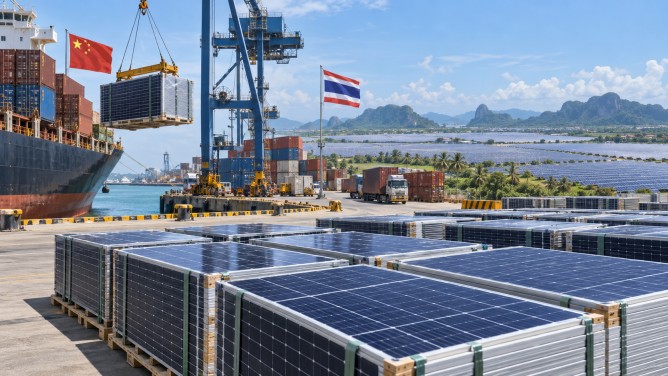
Thailand’s ambitious solar initiative could soon bring significant energy savings to households as the government rolls out a new solar installation program. With plans to subsidize solar panel installations by THB50,000 per household, the program aims to reach one million homes initially, potentially expanding to 1.5 million. This effort is not only expected to reduce electricity costs but also bolster the country’s clean energy infrastructure.
Supporting this initiative, Thailand has seen a dramatic increase in solar panel imports, with figures soaring by 88.7% year-on-year to US$426.7 million in the first seven months of 2026. A staggering 99.3% of these imports came from China, which alone accounted for US$423.9 million, marking a 107.1% increase from the previous year. These imports are crucial to meeting the demands of the upcoming solar program.
In contrast, imports from other countries such as Singapore and Hong Kong remain minimal, each contributing around 0.3% to the total import value. As Thailand relies heavily on Chinese solar panel technology for its current needs, the government is also exploring strategies to nurture local manufacturing capabilities.
Efforts to strengthen domestic production include collaborations between Thailand’s Ministry of Labour and other government bodies to train workers in solar panel assembly, installation, and maintenance. Additionally, discussions with the Board of Investment aim to lower duties on production inputs that cannot be sourced domestically, thereby encouraging local manufacturing.
Thailand’s focus on renewable energy and reducing reliance on imports aligns with its broader goals of developing a sustainable, domestic clean-energy supply chain. By increasing rooftop and ground-mounted solar installations, the government hopes to pave the way for a more energy-efficient future, benefiting both the economy and the environment.